To commission a unique and individually crafted memorial is not always as expensive as people might think.
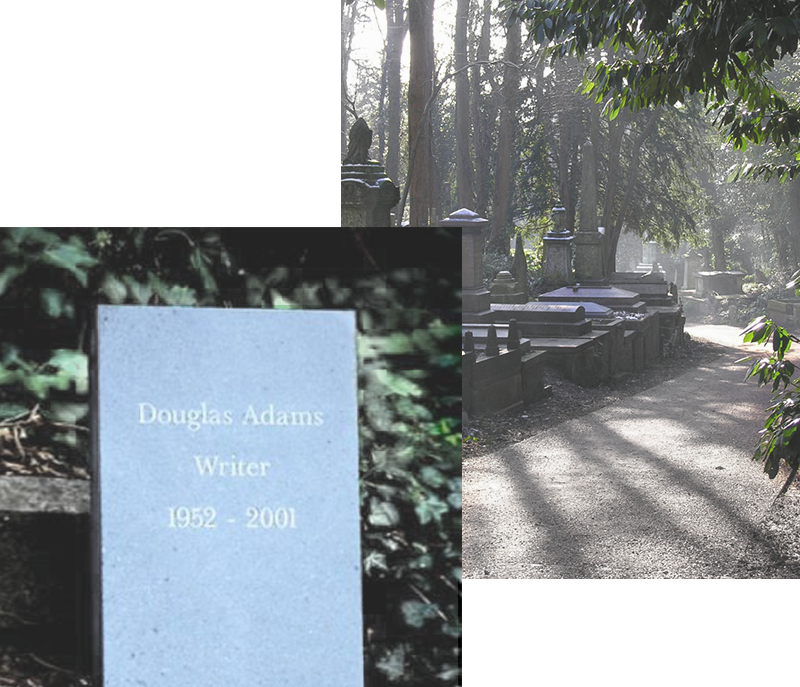
To understand how memorials can be beautiful, take a tour of the cemetery. See how the design and inscriptions still move you today. In modern cemeteries the picture is usually very different. More often than not the norm here is for sterile, mass produced stones, with mechanical lettering. An analogy, to help understand the distinction, might be the comparison between a print and an original painting.
Memorials that are personal, unique and in harmony with their environment are works of art. This can apply to even the most modest memorial. For many people commissioning a memorial may be the only opportunity they have for creating a work of art with a living artist craftsman.
During the 20th century the work of Eric Gill and David Kindersley led to the revival of interest in letter cutting.
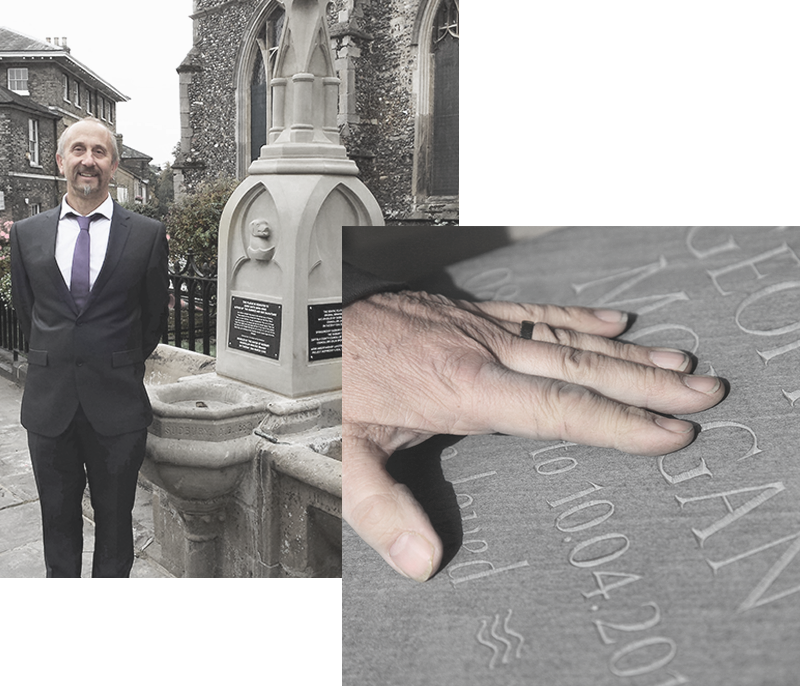
This led to the artist letter cutter studying and becoming highly skilled in the face, form and design of lettering. Neil Luxton can explain and demonstrate the different lettering approaches, to illustrate how letters cut by machine compared to those carved by hand achieve a different dimensional quality.
Neil Luxton is experienced in cutting letters in a wide variety of different forms, styles and languages. Importantly, Neil undertakes the entire production process – from design, through letter cutting and carving, to creation in order to ensure compatibility and empathy at every stage of the process. This is in complete contrast to the segregation of responsibilities that exist in the commercial world; which usually means that the resulting effect is often sterile, harsh and dispassionate.
The selection of stone available is wide ranging, but generally falls into four main categories:
Slate is finely particled, with a layered structure. This enables it to be beautifully carved. One of the main advantages of slate is that it will support the finest lettering. It will appeal to those that wish the memorial to remain the same for years, because it weathers very slowly.
A wide range of soft, tonal colour and textures are available. Limestones are easy to carve and the colour mellows gently, with weathering. It will appeal to those that want medium sized lettering and a gentle weathering process.
Sandstone is a porous stone that ages and blends with the environment within a few years. It requires very deep cut lettering and hence, is more suited to simpler inscriptions.
Granite is a very hard stone, which is expensive to carve. It does not suit fine lettering and is better suited to large scale, simple inscriptions. Polished granite is no longer permitted in Highgate Cemetery as it is unsympathetic to the setting. However unpolished and rustic granite may be used.
Unlike most other activities today the entire memorial process does not need to be rushed. The following summarises the key stages of commissioning and producing a memorial.
At the initial consultation Neil will spend most of the time listening and helping friends and family formulate their thoughts and ideas.
Many people then go home, to consult further with other friends and family. A further meeting or discussion with Neil may follow.
(roll cursor over image)
This is one of the most personal aspects of the entire memorial. Some people find the whole process both an integral and constructive part of coming to terms with their loss.
Neil then produces a design for the memorial. This is sent with a quotation. The quotation provides a detailed analysis of the costs for the stone, lettering, sculpture etc. Some changes may be required and, if so, Neil will undertake these and produce a final proof.
The final proof must be signed off by the grave owner(s) and a 50% deposit paid, before the stone can be ordered.
The stone is ordered. This generally takes 12 to 16 weeks.